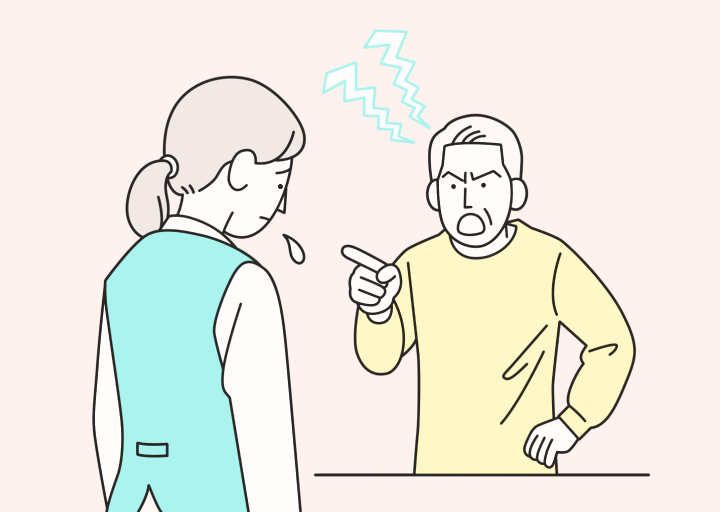
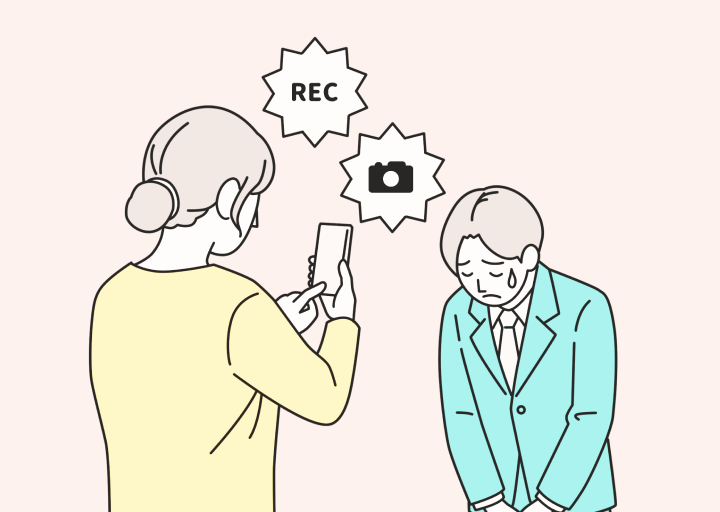
Customer harassment refers to significant disruptive behavior by customers and other members of the public (hereinafter, customer(s)) toward employees that negatively impacts the work environment.
Significant disruptive behavior is defined as an assault, threats, or other illegal acts; excessive demands without a legitimate reason; abusive language; or other unjustified acts.
About the Tokyo Customer Harassment Prevention Ordinance
The Tokyo Metropolitan Government enacted the Tokyo Customer Harassment Prevention Ordinance to help build a fair and sustainable society in which customers and all workers treat one another with mutual respect and stand on an equal footing.
The Ordinance states: “No person shall engage in customer harassment in any situation.” Let us work together as community members to build a better society free from customer harassment.
Customer harassment can be broadly categorized into three types.
Demands made by customers that have no reasonable basis
Specific examples:
Demanding that a worker replace a perfectly good product with a new one,
Demanding that a worker sell a product unrelated to the products the worker usually handles,
and so on.
Regardless of whether the customer’s demand is reasonable, the means and manner used to pursue that demand are unlawful or clearly inappropriate by normal social standards
Specific examples:
Engaging in acts such as throwing an object at the worker or spitting on the worker,
Engaging in such acts as posting images of a worker’s face, nametag, or other identifying information on social media or other platforms without the worker’s consent,
and so on.
In light of whether the customer’s demand is reasonable, the means and manner used to pursue that demand are clearly inappropriate by normal social standards
Specific examples:
Demanding that a worker exchange the product for another item that is, by ordinary social standards, extremely expensive or difficult to obtain compared with the product originally provided,
Demanding monetary compensation that is significantly higher than socially accepted norms in light of the value of the product or service originally provided,
and so on.
For Customers
Customers should understand that their words and actions may constitute harassment. Anyone can be a perpetrator, so be mindful of how words and actions affect workers.
When expressing legitimate complaints or opinions, it is important to choose an effective way to communicate and endeavor to remain calm so that anger does not escalate into harassment.
⚫︎ Key points for communicating opinions
(1) Pause a moment
(2) Be specific
(3) Listen to what the other person is saying until they finish speaking
(4) Consider the other person’s circumstances (e.g., a worker)
(5) Be considerate towards the other person
According to the Ordinance, “In applying this Ordinance, care must be taken not to unreasonably infringe upon the rights of customers (Article 5).”
On the other hand, it should be remembered that being a customer does not mean that any behavior is acceptable. We should all be mindful of communicating in an appropriate manner.
For Business Operators
Initiatives as Business Operators
Business operators have responsibilities to take proactive, positive measures to protect their employees from customer harassment. To create a safe and comfortable work environment, implement the following measures:
Initiative 1 Clarify and communicate basic policies and fundamental stance on customer harassment both internally and externally
Clearly communicate your basic policies and stance on preventing customer harassment to both workers and external parties. Ensure that workers are informed of your policy and that they themselves must not engage in customer harassment.
Initiative 2 Establish a consultation desk and system
Set up a consultation desk for workers experiencing customer harassment and develop a system that enables designated personnel to respond appropriately.
Initiative 3 Prepare a manual to prevent harm
To prepare for situations in which customer harassment may occur, develop a response manual outlining initial on-site actions, measures to protect the safety of workers who experience harassment, guidance on how to provide for their mental and physical care, and internal procedures and methods on how to handle cases of harassment.
Initiative 4 Support for those who experience harm
In the event of a case likely involving customer harassment, verify all facts accurately, respond to the case, ensure the safety of the affected worker, and provide necessary mental and physical care.
Initiative 5 Education and training for workers
Regularly provide workers with education and training on specific responses to customer harassment. In particular, executives are required to evaluate the impact of customer harassment on the business and to prioritize their responses accordingly. Therefore, an effective approach is to encourage them to take proactive measures by raising their awareness through training sessions led by external instructors.
Initiative 6 Periodic reviews and ongoing improvements
To address problems, including legitimate complaints and instances of customer harassment, share both successful and unsuccessful examples from your organization and consider ways to improve services. It is good practice to conduct periodic reviews to assess your efforts and implement improvements.
Considerations for people with disabilities and dementia
Legitimate complaints should not be unfairly restricted, as they can lead to operational improvements and the development of new products or services. Additionally, it is important to keep in mind that some customers, including those with disabilities, may require reasonable accommodations.
For Workers
Workers should be interested in the social context in which customer harassment occurs and what actions constitute it. They should also deepen their understanding of whom to consult and how to respond when affected. On-site supervisors, in particular, must fully understand the above, as they have responsibilities to protect the health and safety of on-site workers.
- It is also important to understand that workers have an equal relationship with customers and to learn how to communicate to prevent harassment by customers. This includes developing effective ways to respond to customer complaints and feedback.
- When business operators promote their initiatives to prevent customer harassment, such as through training and awareness activities, workers should also actively participate in and cooperate with these efforts.
Customer harassment (known as Kasuhara) viewed as videos
We have created videos summarizing key information on customer harassment.